


Recently,a team led by Professor Yangyang Chen from Southeast University'sSchool of Automation, in collaboration with Dr. Kaiwen Chen andProfessor Alessandro Astolfi from Imperial College London, The latestresearch results on hierarchical adaptive formation tracking controlunderthe influence of uncertain time-varying external systems werepublished online in the form of a Full Paper in IEEE Transactions onAutomatic Control, a top international journal in the field ofcontrol. The related work was supported by projects such as theNational Natural Science Foundation of China. Liu Tianrun, a doctoralstudent in the team, is the first author of the paper, and ProfessorChen Yangyang is the corresponding author
Formationtracking control of multi-agent systems plays a crucial role inincreasingly interconnected modern application scenarios such asunderwater detection and satellite navigation. However, in complexreal-world environments, the external system that describes thereference target and the perturbation outside the system oftencontains unknown time-varying parameters. For the complex formationtracking problem in general directed graph communication topologies,this study ingeniously introduces the variable condensation methodand proposes a new set of "estimator-controller"hierarchical adaptive control framework. This study demonstrates theboundedness and convergence of the state of the closed-loop adaptivesystem through rigorous theory, and verifies the effectiveness of theproposed architecture through simulation. This achievement not onlyprovides a solid theoretical support for dealing with high-ordernonlinear multi-agent systems with complex time-varyinguncertainties, but also opens up new ideas for the safe cooperativecontrol of unmanned systems.
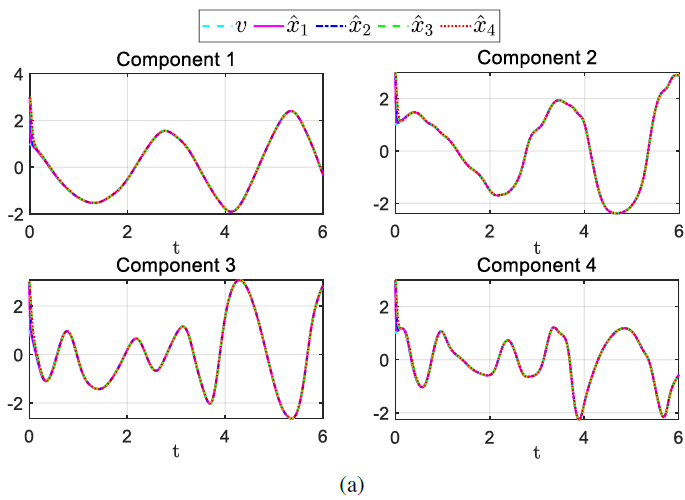
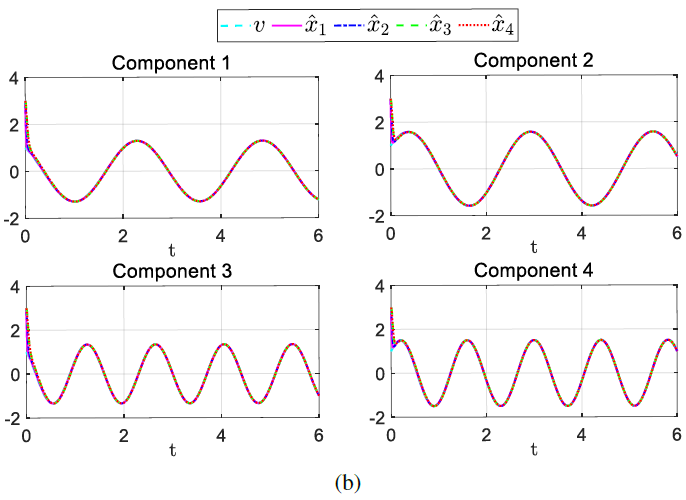
Estimationof performance: (a) time-varying parameter conditions; (b)time-invariant parameter situation.
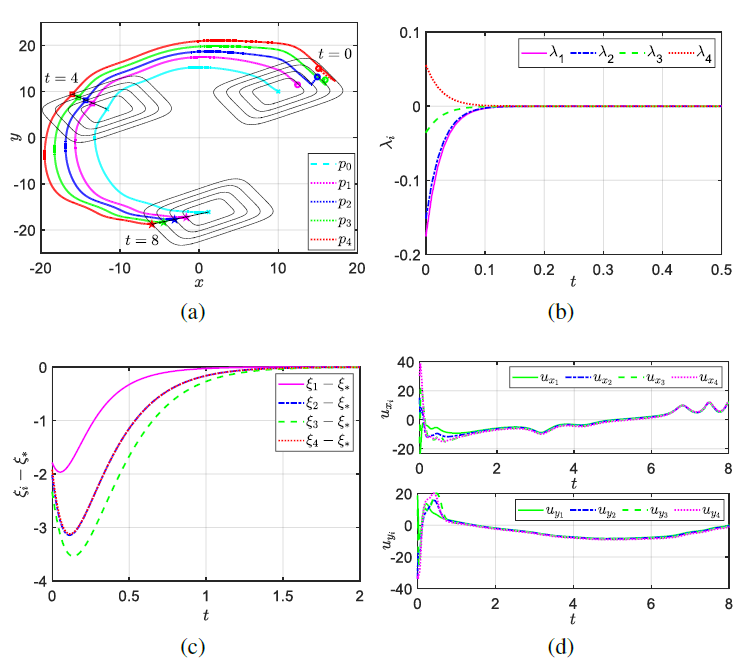
Formationtracking performance: (a) trajectories of the agent and the target;(b) Response curve of orbital tracking error; (c) Response curve offormation error; (d) Response curve of the control signal.
Thepaper is available at:https://ieeexplore.ieee.org/document/11417890


